Reflock-II/100MHz Frequency Stability
One way to generate a high stability, low phase noise reference signal is to use a phase lock loop to slave a low-noise oscillator at, say, 100MHz to a high stability oscillator at a lower frequency. The TAPR CT1DMK Reflock-II does just that. Luis Cupido, CT1DMK, conceived the Reflock as a universal frequency lock device; it can be configured to lock virtually any voltage-tuned oscillator to a stable frequency reference.The Reflock-II is a really versatile device, and it's easy to imagine lots of applications for it. One that came readily to mind was to provide a replacement oscillator for the SDR-1000.
So, rather than using a high-stability low frequency (e.g., 10MHz) oscillator to drive the SDR-1000 directly, the Reflock II can lock a higher frequeny voltage controlled crystal oscillator ("VCXO") to a lower frequency temperature compensated crystal oscillator ("TXCO") to get low phase noise combined with better frequency stability.
Steve designed a small daughterboard for the Reflock-II to do just that. It includes a 10MHz TXCO to provide accuracy, and a low jitter VCXO for low phase noise (the VCXO runs at less than 200MHz and therefore still needs to be multiplied in the DDS chip, but with a lower multiplication factor and hence less increase in phase noise than if we used a low-frequency reference directly). To be specific, the Reflock-II that I tested had a Crystek ECS-39SM 10MHz TXCO controling a 100MHz CVHD-950 VCXO.
To see how the Reflock-II with Steve's daughterboard works, I ran a set of tests similar to those for the SDR-1000 with its original oscillator (see https://febo.com/geekworks/sdr1k/sdr1k_vf/index.html for that data).
The measurements were taken by an HP5370B frequency counter driven by an HP 5065A Rubidium frequency standard. I took frequency readings every five seconds and logged them to a disk file (well, *I* didn't take the readings; a software program communicating with the 5370B via the GPIB bus did the logging). I also measured the ambient temperature near the Reflock-II using a Temp-Trax 2000 RS-232 thermometer. For the frequency vs. temperature plots, I measured the temperature at 1 minute intervals and used every 12th record from the frequency data to match that rate.
When comparing this data with that for the SDR-1000 oscillator, please note that (a) the Reflock-II was operating in the open air without any enclosure to shield it from drafts, or other heat-generating gear nearby; and (b) that while the Reflock-II was operating at 100MHz, I've scaled this data to 50MHz, to allow direct comparison between the two units. I also made no attempt to adjust the 10MHz TXCO to be precisely at 100.000MHz -- the adjustment was left as I received it from N7HPR.
While the original oscillator in the SDR-1000 is not bad in comparison to many HF rigs, the Reflock-II system is clearly much -- over an order of magnitude on every measurement -- better. That's to be expected from a much more sophisticated (and expensive) frequency control system.
First, how long did it take the system to warm up and reach stability? From a cold start, this is what the first 60 minutes of operation looks like.
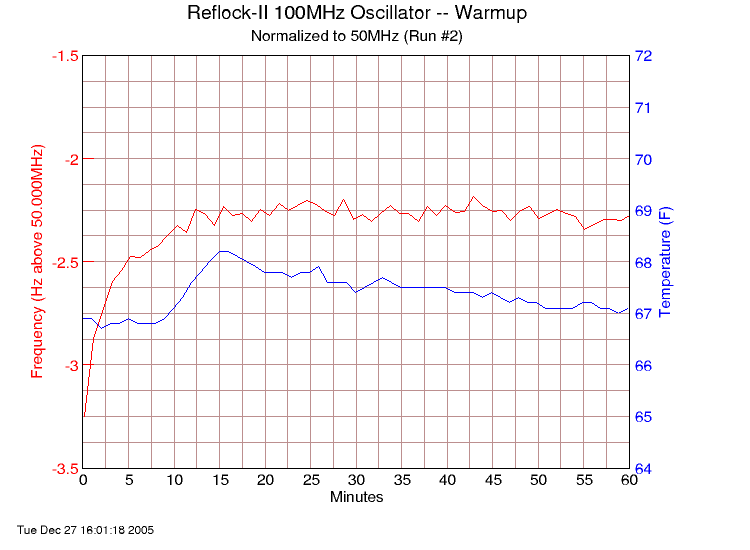
The warmup drift is only about 3Hz, and that's almost all in the first 15 minutes. I don't know how much of this drift is related to normal warmup factors, and how much is the Reflock-II control loop settling down. In any event, the drift is small enough to be considered "nominal."
Next, how stable is it after warm up? This is data showing the full run; the startup drift is small enough that it doesn't affect the overall plot.
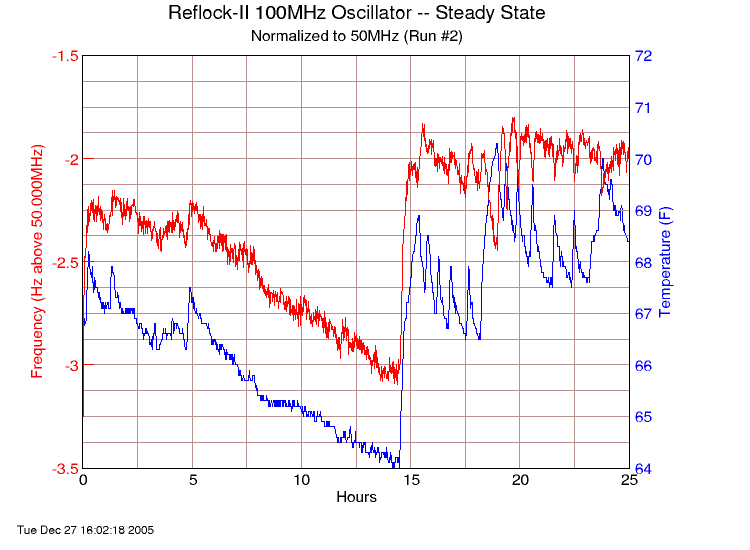
This was an overnight data run, and thanks to my setback thermostat we can clearly see the frequency versus temperature curve of the Valpey-Fisher oscillator. As the temperature gradually decreases overnight, the Reflock-II frequency drops. Then, when the furnace (forced hot air) kicks on in the morning, there are sharp upward temperature spikes, matched by upward frequency shifts. Note, though, that only the first (and largest) temperature spike is matched by a significant frequency shift (though "significant" here means only a little more than 1Hz). I suspect that the temperature increased faster than the TCXO's contol loop could follow, but later, smaller spikes were within the control loop range. Note that the SDR-1000 oscillator showed about a 32Hz swing over a smaller temperature range).
I wouldn't want to extrapolate this over too wide a temperature range, but there was about a 1.8Hz upward frequency shift for a 4.9 degree (F) temperature increase. That's 0.37Hz/degree at 50MHz, or +7.4x10⁻⁹/degree (0.0074ppm).
Finally, a measure of frequency stability often used in the time and frequency community is the Allan Deviation. The Allan Deviation is somewhat like a standard deviation measurement over a sampling period. Here is a plot of the Reflock-II's stability (the warm up period was excluded) based on the "run 2" data shown above:
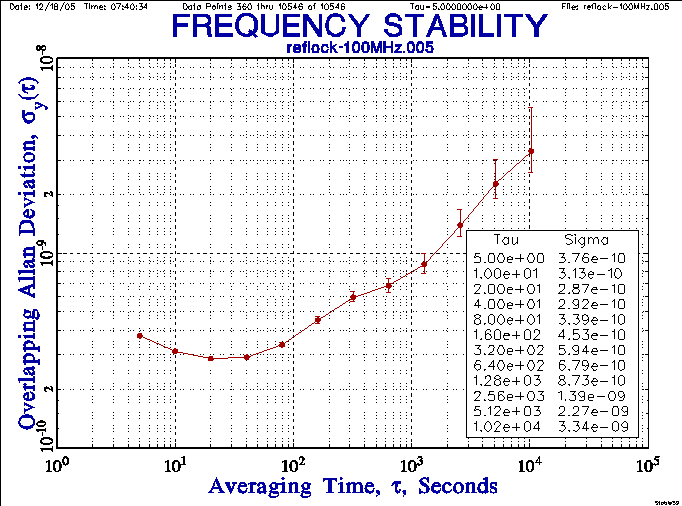
This shows the stability over sampling periods of 5 to 10,240 seconds. These results are very good. The shortest "tau" (sampling period) show better stability than the longer ones, mainly because of the temperature- related frequency excursions.